Editable worlds, practical pipelines. Ten developments connecting new representations with the tools that make them usable.
20 November 2026 · Friday 09:00 Pacific Window: 13 Nov, 17:00 UTC ≤ event < 20 Nov, 17:00 UTC. News cutoff: 20 November, 17:00 UTC; verification completed after cutoff.
Showing 10 of 10 selections
01
Research / 16 Nov · preprint
If the image does not load, open the original figure.Gokbudak et al. · CC BY 4.0 · unaltered, scaled. Original image ↗
A material library in a shared code space
One Code per Material represents each measured material with 256 numbers conditioned on a shared 32.3-million-parameter decoder. The important idea is a common space for measured appearance: the authors also train a class-conditioned generator on 84 materials. The small code is not a self-contained 256-number asset. Their compact model improves colour accuracy and PSNR against one neural baseline, while perceptual sharpness measured by LPIPS is worse.
Our takeWatch this as material-authoring research. Decoding a generated sample into a light–view table took 3.7 minutes on an A100; the paper does not establish instant runtime generation.
Fazilet Gokbudak, Canberk Baykal, Chenliang Zhou, Rafal Mantiuk and Cengiz Oztireli. v1 submitted 16 November at 11:59:23 UTC. Figure 8 shows generated samples under moved point lighting. The caption carries no separate third-party exclusion; paper license is CC BY 4.0. Unchanged image, scaled to fit.
SceneAnything coordinates agents that turn camera, depth and segmentation estimates into parameterized Blender scene generators. Its application examples move objects and change lighting; unseen regions are inferred rather than recovered evidence. This is research, not a released Blender plugin. The paper covers 100 scenes, but its main comparison with other video-to-3D methods uses only ten alignable scenes.
Our takeEditable components could be more useful for level blockouts than a single opaque reconstruction. Continuous single shots, limited non-rigid motion and stronger results with commercial models remain constraints. Code and data are promised, not verified released.
Bowen Xue, Saeed Hadadan, Fabrice Rousselle, Zahra Montazeri, Ravi Ramamoorthi and Milos Hasan. v1 submitted 19 November at 01:26 UTC. Figure 5 illustrates edits and relighting. The arXiv non-exclusive deposit license is not a figure-reuse grant; inline image omitted.
Unity announced CLI 1.0 and the local Editor package com.unity.pipeline 1.0, moving this automation interface out of beta. Commands can work with a live Editor session, giving scripts and coding agents a more structured route into project operations. Treat this as development tooling, not a new generated-asset system or evidence that an agent can reliably finish a game.
Our takeTry a small, repeatable editor task first and inspect the resulting project diff. A command-line surface is useful when it makes automation observable and reproducible.
Christopher Addison / Unity, announcement dated 17 November. The CLI announcement illustration is linked below; no independent image-reuse permission established, so it is omitted inline.
WEBP, 1609 × 965, 33,348 bytes decoded in cloud. Original image.
Godot 4.8 beta 4 packages 123 fixes from 58 contributors. The highlighted changes include Trail3D points scaling incorrectly, VoxelGI escaping non-uniform bounds, and text-format version handling for saved scenes containing metadata or embedded scenes. This is a prerelease snapshot, not the final 4.8 release; the fresh event is their inclusion in this beta.
Our takeUse a separate test branch before resaving affected scenes, then check downstream tools and older editors. A serialization change deserves as much attention as a rendering fix.
Thaddeus Crews / Godot, 18 November; build b070e63b1. The source cover depicts JOHN GLEEP by monthbug, not these fixes. Image fetch returned HTTP 403 and reuse rights were not established; image omitted.
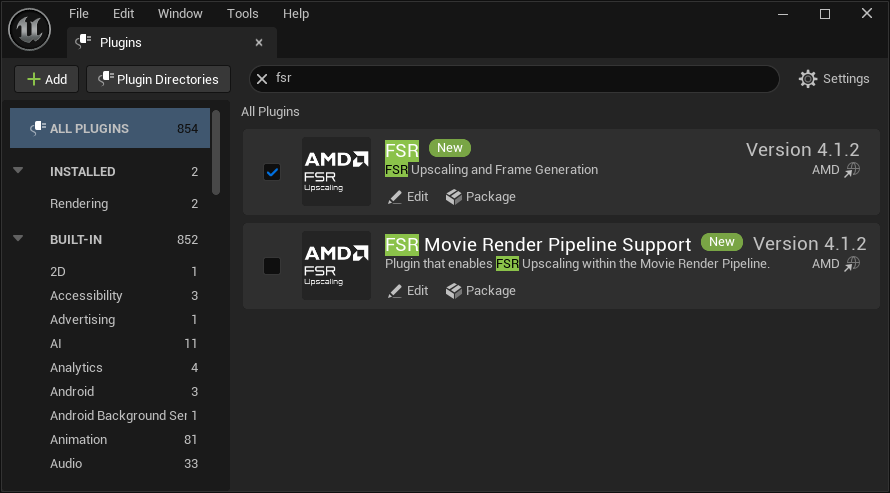
AMD announced Unreal plugin 4.1.2 with ML upscaling support for Radeon RX 6000 discrete GPUs and selected Ryzen integrated graphics. The plugin targets Unreal Engine 5.3–5.8 and DirectX 12, selecting hardware-appropriate INT8 models and retaining analytical FSR 3 fallback where needed. November 16 is the announcement date; the guide carries an earlier date, so this is not a claim about first download availability.
Our takeTest the actual target GPU and fallback path. The separate SDK’s Vulkan work does not make this Unreal plugin a Vulkan integration.
Alexander Blake-Davies / AMD GPUOpen, 16 November, page metadata 21:00 UTC. The original Editor-settings screenshot is linked; no image-reuse permission verified, so no inline display.
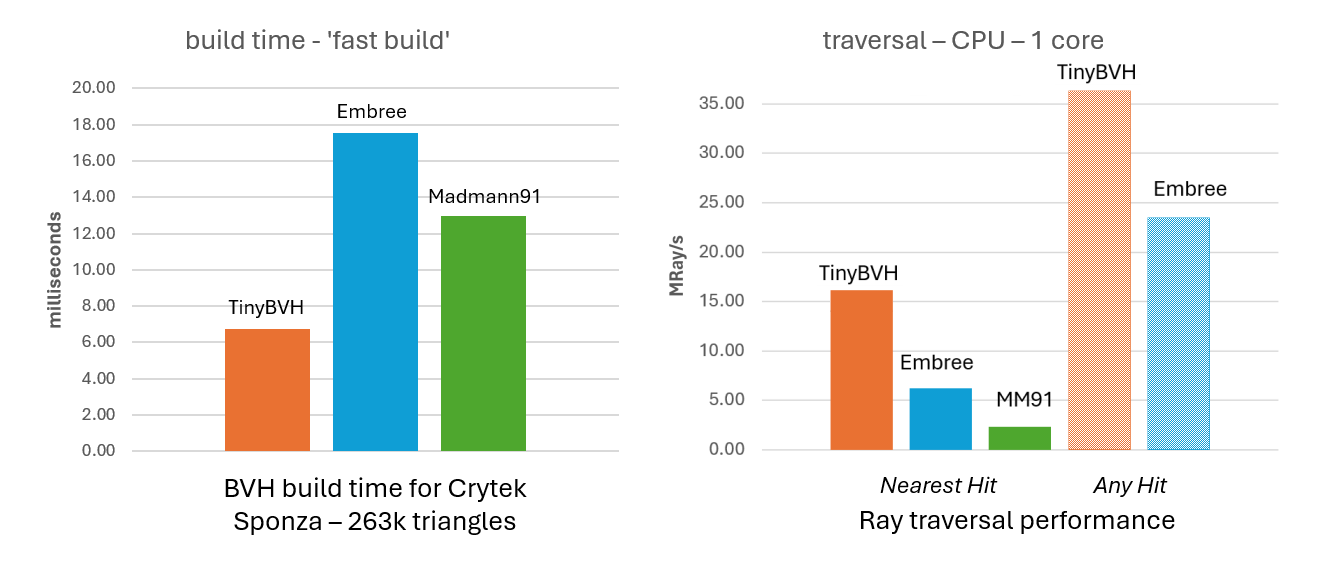
TinyBVH 1.9.2 merged into main with an AMD RDNA4 hardware-format BVH8 and a separate experimental BVH_DOBB layout using discrete oriented boxes. Those are different additions: hardware intersection compatibility on one side, tighter bounds around awkwardly oriented geometry on the other. This is a verified main-branch update, not a packaged GitHub Release.
Our takeBenchmark representative scenes before choosing a layout. The older oriented-box research and the README’s basic-layout throughput figures are not measurements of these new options.
Jacco Bikker / TinyBVH contributors; PR 317 merged 14 November at 13:11:49 UTC, commit 3dbdc2a575ee6fc531d1ef91c763fccd8ebb8c96. The pinned README graph compares builders, not these layouts; image omitted for relevance and unverified figure rights.
If the image does not load, open the original figure.Yılmaz et al. · CC BY 4.0 · unaltered, scaled. Original image ↗
Training dynamic splats beyond GPU memory
DOOM-GS stores a full dynamic Gaussian model on SSD, caches space–time blocks in RAM, and stages the blocks needed by a camera batch on the GPU. Scheduling neighbouring views improves reuse. On the authors’ synthetic 20-million-Gaussian Block scene, training took 37.2 hours versus 54.2 for their dynamic TideGS adaptation, with GPU cache hits of 89% versus 78%.
Our takeThe useful result concerns training memory and scheduling. It is not a playback-FPS claim, and the controlled synthetic comparison does not establish production-game performance.
Doğa Yılmaz, Jialin Zhu, Binglun Wang and He Wang. v1 submitted 17 November at 14:00:20 UTC. Figure 1 is the authors’ method diagram; no separate figure-rights exclusion found. Paper license CC BY 4.0. Unchanged image, scaled to fit.
CARLA turns camera optics into a simulation concern
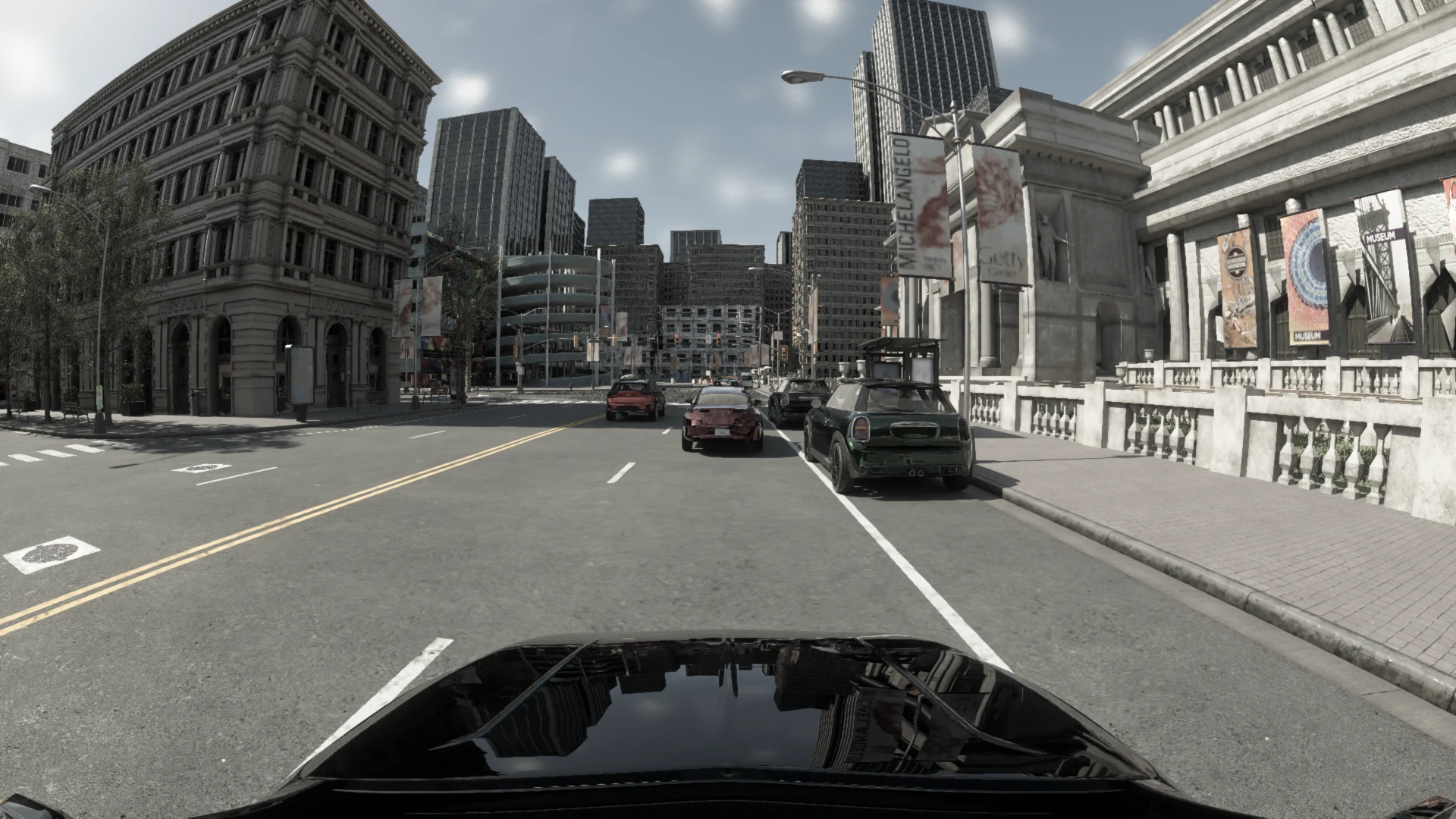
CARLA 1.0 moves its driving simulator to an Unreal Engine 5.8 fork and adds ray-traced lens models alongside a broader synthetic-sensor workflow. Its fisheye examples make the practical distinction visible: camera geometry changes the data a virtual sensor sees. This is an adjacent simulation workflow, not a game release.
Our takeFor synthetic-data projects, evaluate the lens and sensor model alongside visual polish. The Cosmos capture client, CLI and mock pipeline ship, but the model-running GPU workers were still being validated in the release notes.
CARLA team / @Madecu, release post dated 17 November. The linked image is the same scene through a 150° Kannala–Brandt fisheye lens. Separate permission for that illustration was not verified; omitted inline.
WEBP, 1920 × 1080, 360,222 bytes decoded in cloud. Original image.
Meshy’s November 18 changelog adds quadruped rigging to its API, with animation_type set to quadruped and matching animation clips identified by rig type. This is an API-layer update, not a claim that animal rigging first appeared in its web app. Inputs need suitable textured GLBs, at most 380,000 triangles, facing +Z.
Our takeValidate both the skeleton and the returned animation URLs before importing. A successful rig can still lack walking or running files; humanoid skeleton and finger options do not apply to quadrupeds.
Meshy API changelog, 18 November; rigging and animation-library documentation checked. The linked dog-walk GIF is an official library preview, not a test run performed for this issue. Reuse permission not established; omitted inline.
The DIRECTOR’S CUT! diary places its completed build and write-up on November 15. The two-person team reports 31 Meshy meshes, 30 generated through Claude Code and Meshy’s MCP server. Triangle budgets, scripted imports and visual play tests mattered as much as generation. One hang-glider came out almost flat; an image-to-3D route supplied a usable alternative.
Our takeThe transferable idea is a repeatable import-and-check loop with explicit asset contracts. These are this team’s reported results, not a controlled productivity study or a claim about every jam entrant.
Four Swords Pictures: arglifed and Hendrixsan; diary timeline records “ship it” and this write-up on 15 November. The live relative posting label is not used as an exact timestamp. Case-study illustration rights were not established; an individual asset license does not license the whole illustration.
PNG, 1280 × 1800, 1,772,973 bytes decoded in cloud. Original image.
What made the cut
Ten dated developments in the seven-day slot window. Preprints are research claims; announcements and case studies remain attributed to their authors. CARLA is included as an adjacent engine-and-simulation workflow. Our take is editorial interpretation, not a benchmark.
Earlier Blender, Evergine and O3DE splat releases were excluded. Scheduled conference talks alone were not treated as delivered technical results.
Images, honestly
The two inline paper figures are remotely loaded from arXiv under CC BY 4.0, with attribution and original links. Their bytes decoded and the figures were visually inspected. The other eight cards link the extracted original image but omit display because rights were not established, relevance was limited, or access failed. Only material with verified public reuse rights is shown inline.
Remote hosts can refuse a browser request. Each figure has a persistent original link and an error fallback. No image bytes, analytics or external scripts are embedded.
AI-assisted editorial aggregation; primary papers and official sources are credited on each card.